
Bitbucket Integration
The Conviso Platform integration with Bitbucket Cloud connects your workspaces and repositories to the platform. Once connected, you can import repositories as assets and enable automated security scanning on pull requests and after merges.
Setup has three steps: Login (OAuth with Bitbucket), Authorization (select workspaces and repositories), and Configuration (manage assets and scan toggles).
This guide covers the Application Lifecycle Management (ALM) integration (repository manager).
For running Conviso AST inside each repository’s own bitbucket-pipelines.yml, see the Bitbucket Pipelines CI/CD guide.
Objective
By the end of this guide, you will have:
- Connected a Bitbucket account to Conviso Platform via OAuth.
- Authorized workspaces and imported repositories as assets.
- Understood how to enable Scans on pull requests and AST scans on merge.
Prerequisites
- A Bitbucket Cloud account with access to the workspaces and repositories you want to connect (admin recommended for webhooks and Pipelines).
- Permission to authorize the Conviso Platform OAuth consumer on the Bitbucket consent screen.
- Your Conviso Platform company has the Bitbucket ALM integration available.
OAuth permissions
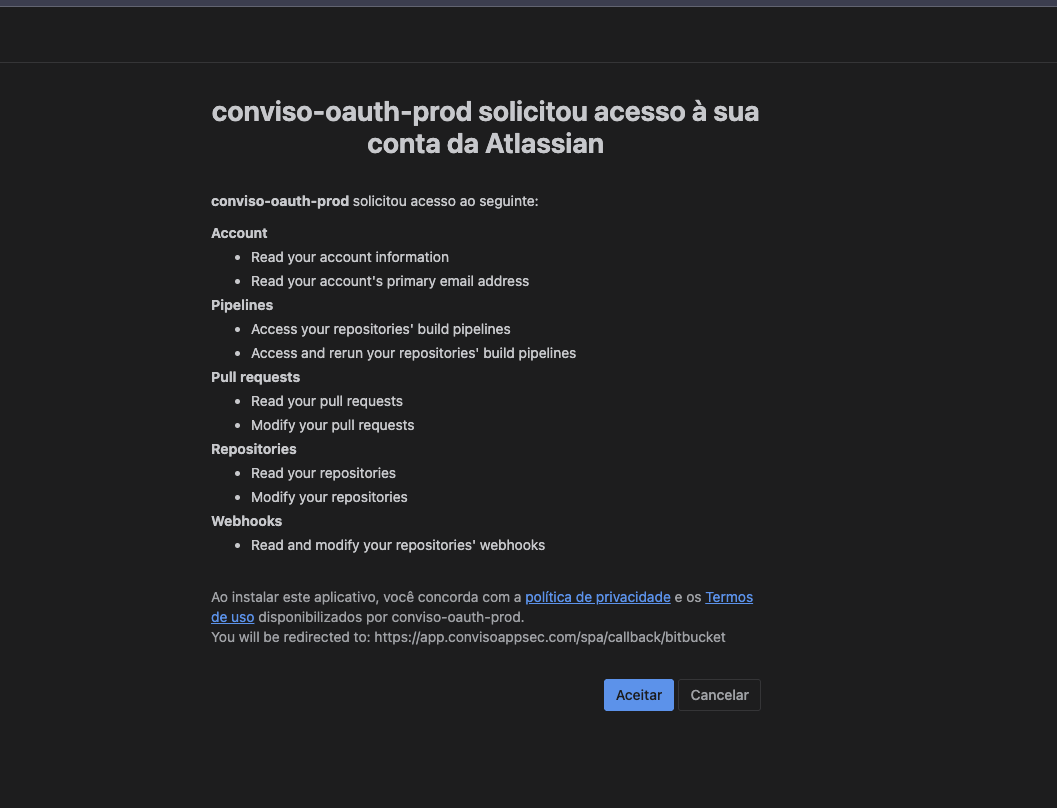
Bitbucket OAuth scopes are configured on the OAuth consumer (not selected per login). Conviso needs access to:
| Need | Why |
|---|---|
| Account / repository read | List workspaces and repositories, import assets |
| Webhooks | Receive pull request and merge events |
| Pipelines (read/write) | Trigger the central AST Orchestrator custom pipeline |
If your organization restricts OAuth apps, an administrator may need to approve the Conviso consumer.
Steps
Step 1 – Open the Bitbucket integration
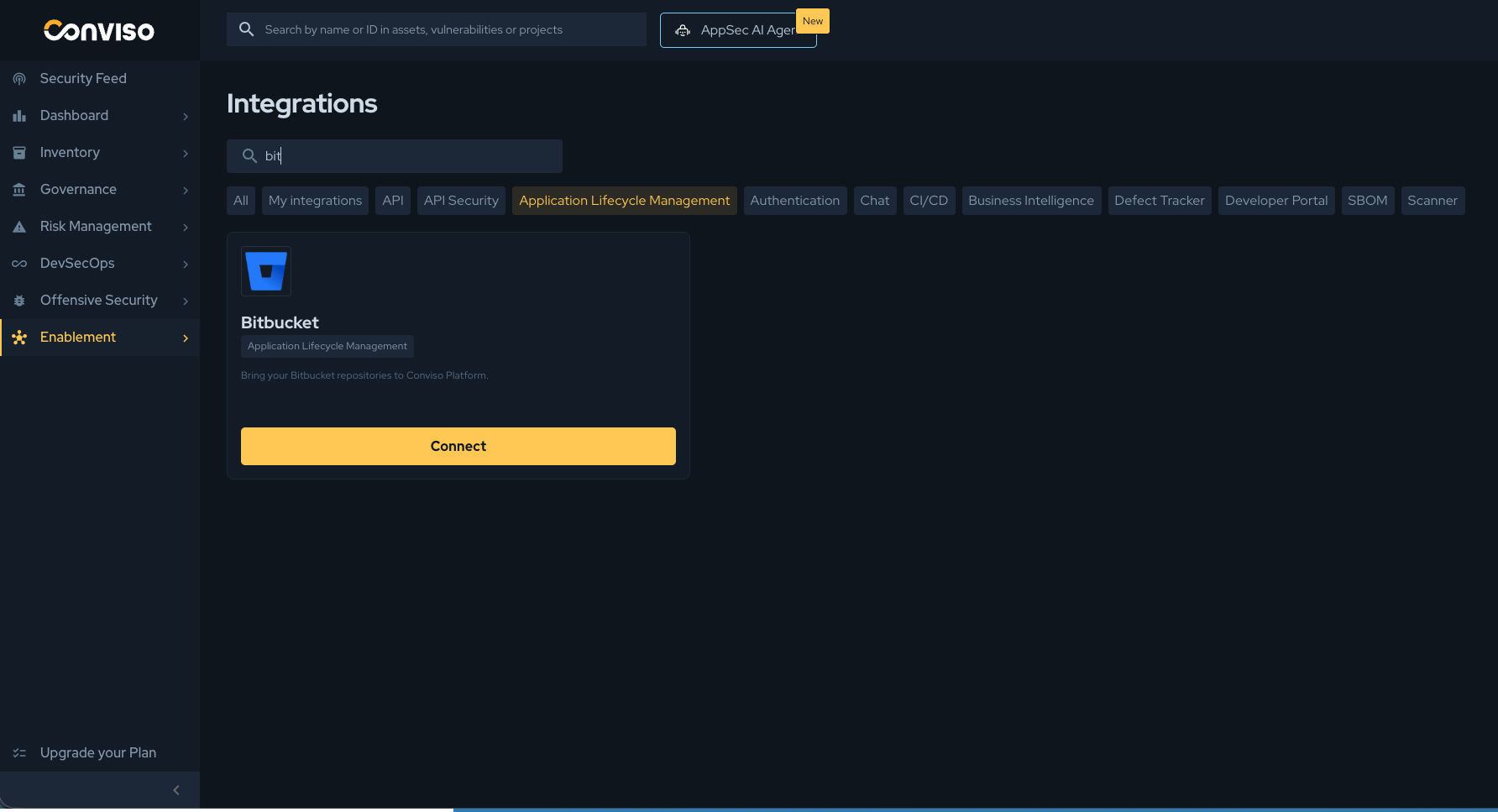
- In Conviso Platform, go to Integrations.
- Filter by Application Lifecycle Management if needed.
- Find the Bitbucket card and click Connect.
Step 1: Integrations page with the Bitbucket card and Connect button.
Step 2 – Connect to Bitbucket (Login)
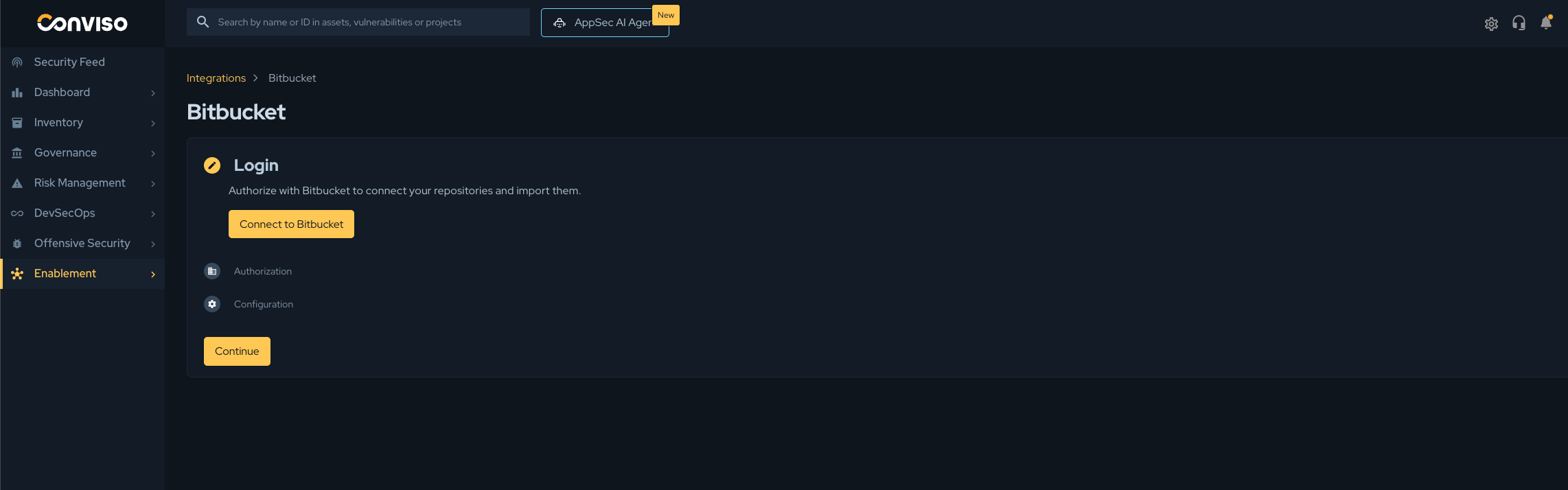
- On the Login step, click Connect to Bitbucket.
- Sign in to Bitbucket / Atlassian if prompted and review the permissions.
- Click Grant access / Authorize.
- You are redirected back to Conviso Platform and moved to Authorization.
Step 2: Login step with Connect to Bitbucket.
Step 2b: Bitbucket / Atlassian consent screen.
Step 3 – Select workspaces and import repositories (Authorization)
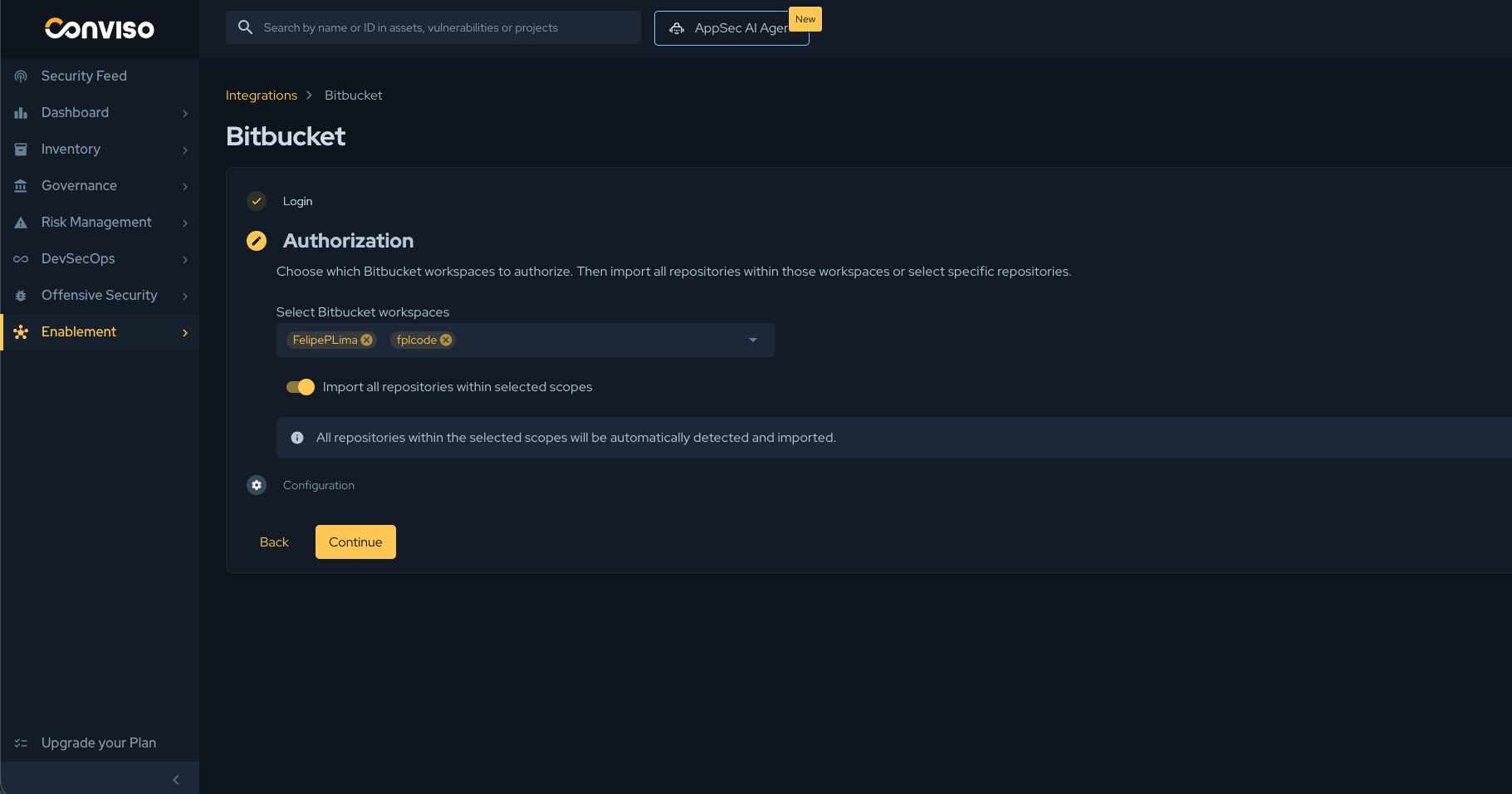
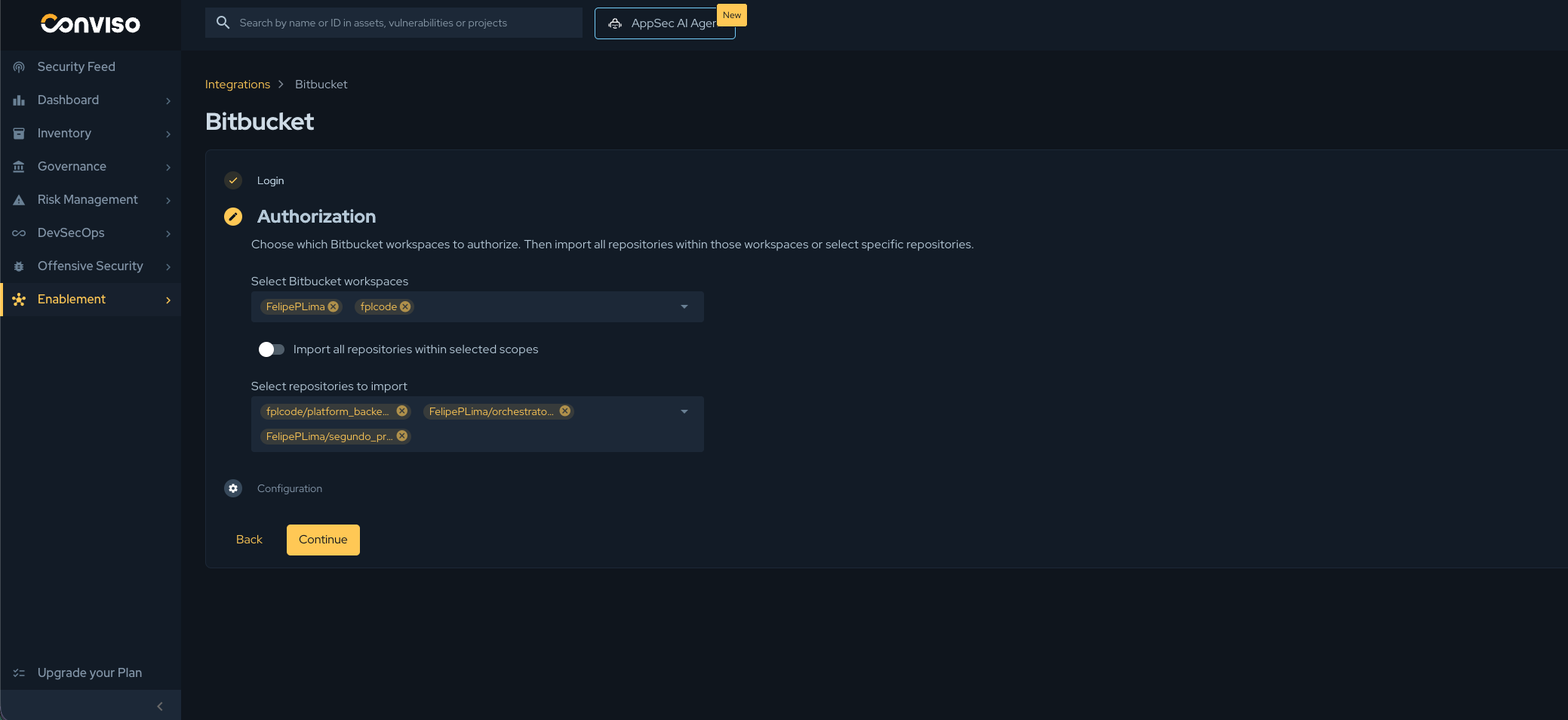
- On the Authorization step, select one or more Bitbucket workspaces.
- Choose how to import repositories:
- Import all repositories within selected scopes: turn the toggle on so Conviso detects and imports repositories in those workspaces (and can keep discovering new ones via workspace webhooks when permitted).
- Select specific repositories: turn the toggle off and choose only the repositories you want.
- Click Continue. Import runs in the background; assets appear on Configuration shortly after.
Step 3: Authorization – select workspaces and import-all toggle.
Step 3b: Selecting specific repositories (when import-all is off).
Step 4 – Configuration
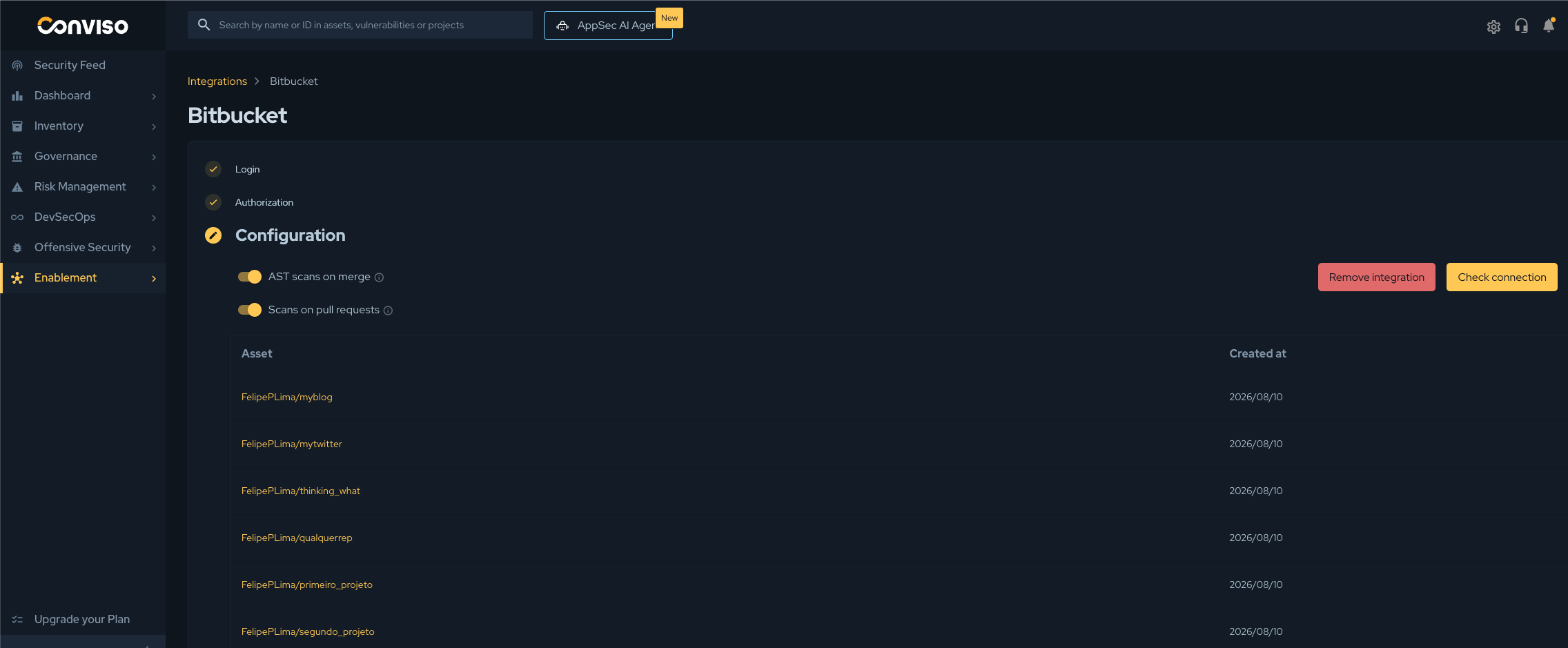
On Configuration you can:
- Browse imported assets (search by name or ID).
- Enable Scans on pull requests (differential scan when a PR is opened or updated).
- Enable AST scans on merge and configure the Orchestrator pipeline (workspace, repository, and ref) — see Bitbucket AST Orchestrator.
- Use Check connection or Remove integration.
Step 4: Configuration – assets, scan toggles, and orchestrator fields.
Scans on pull requests
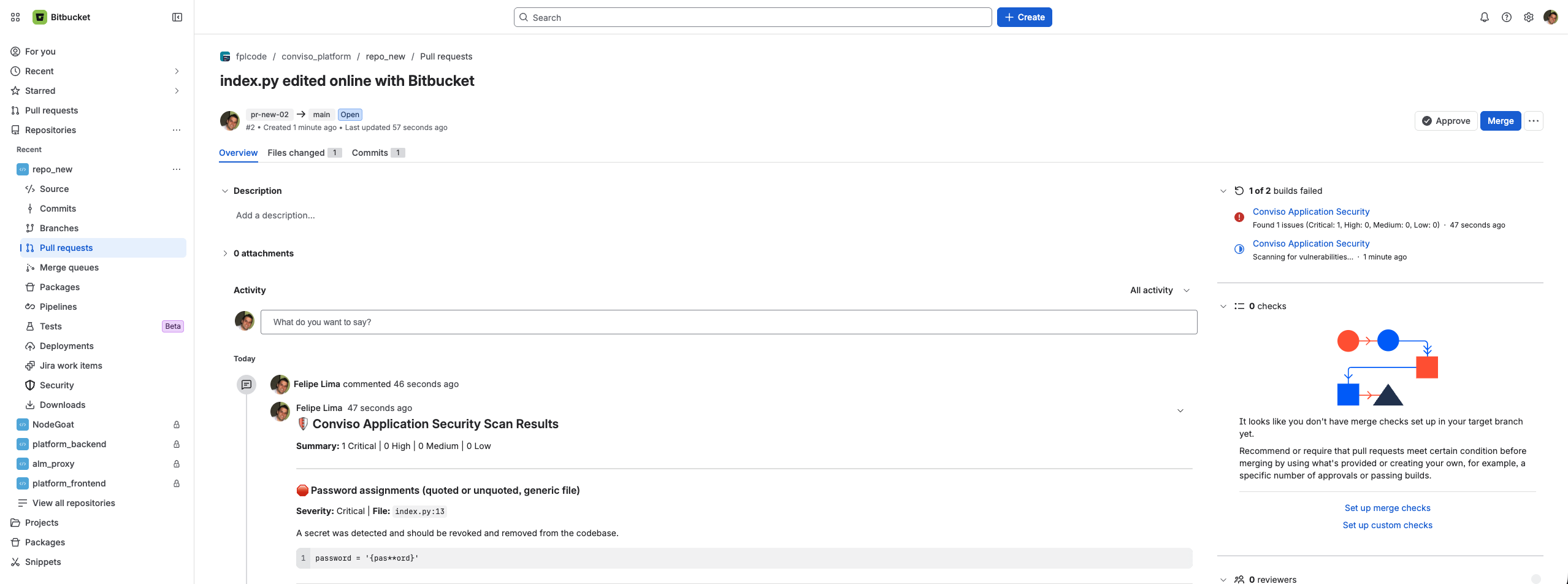
Scans on pull requests give security feedback when a Bitbucket pull request is opened or updated. The scan runs in an environment managed by Conviso — no bitbucket-pipelines.yml is required in the target application repository.
Enabling PR scans
- Open Integrations → Bitbucket → Configuration.
- Turn Scans on pull requests on.
- Ensure the relevant assets remain active in the assets table.
- Open or update a pull request in an imported repository to validate.
Changes apply to new PR events (create/update). Existing PRs update on the next push event.
How it works
- Bitbucket sends a pull request webhook to Conviso.
- Conviso enqueues a differential scan for the head commit.
- Results are reported back as a commit status on the pull request.
Example: Conviso commit status and findings comment on a Bitbucket pull request.
AST Orchestrator (on merge)
For full AST after merge via a single Bitbucket Pipelines repository (no Conviso CI YAML in every application repo), see:
Configure the Bitbucket AST Orchestrator
Validation
| Step | Expected result |
|---|---|
| Login | OAuth completes; Authorization unlocks |
| Authorization | Import starts; Configuration shows assets |
| PR scans | Commit status appears on a PR open/update |
| AST on merge | Orchestrator custom pipeline run-ast-scan runs after merge (see orchestrator guide) |
Troubleshooting
| Symptom | What to check |
|---|---|
| Bitbucket card missing | Company feature flag / contact Conviso Support |
| OAuth fails or loops | Consumer redirect URI and approval; try Reconnect to Bitbucket |
| Import empty | Workspace selected; OAuth user can see those repositories |
| Webhooks / auto-discovery degraded | Workspace admin rights; Bitbucket webhook delivery logs |
| PR scan never starts | Scans on pull requests on; asset imported; webhook reaches Conviso |
| AST on merge never starts | AST scans on merge on; orchestrator workspace/repo/ref saved; Pipelines enabled on orchestrator repo |
Support
If you need help validating OAuth, webhooks, or orchestrator settings, contact Conviso Support.
Related guides
Contribute to the Docs
Found something outdated or missing? Help us improve the documentation with a quick suggestion or edit.
How to contributeResources
By exploring our content, you'll find resources that will enhance your understanding of the importance of a Security Application Program.
Conviso Blog: Explore our blog, which offers a collection of articles and posts covering a wide range of AppSec topics. The content on the blog is primarily in English.
Conviso's YouTube Channel: Access a wealth of informative videos covering various topics related to AppSec. Please note that the content is primarily in Portuguese.